Ranch & Farm Fence in Norman, OK
Ironclad Fence Norman builds ranch and farm fencing across Norman, OK and rural Cleveland County, from east Norman, Little Axe and Slaughterville to Noble and Lexington: barbed wire, woven field fence and high-tensile wire on steel T-posts, with heavy braced corners, cross fencing, water gaps and pasture gates. As a fence company serving Norman, OK, we build the braces first and stretch the wire tight from them, so the fence keeps cattle, goats and sheep where they belong under Oklahoma’s fence-in law. Every project starts with a walk of the line and a written, itemized quote.
Why us
Why Choose Us for Ranch & Farm Fence in Norman, OK
A pasture fence has one job: keep animals in for years without constant fixing. That comes down to the braces and the tension.
-
Heavy Braces First
Corners, ends and gates get H-braces built heavy, because a wire fence is only as tight as its braces.
-
Wire Stretched Right
We stretch each strand or roll of field fence to proper tension and tie it off at the braces, so it doesn’t sag in the first summer.
-
Built for the Land
Closer posts on hills and soft ground, water gaps at creeks, and lines laid out so you can check them easily.
-
Matched to Your Livestock
Strand count, spacing and wire type chosen for what you’re keeping in, from cattle to goats.
Services
Ranch & Farm Fence Services in Norman, OK
From a full perimeter on new acreage to a few cross fences, here’s what we build for Cleveland County farms and ranches. For a rustic boundary without livestock, see split rail.
-
Barbed Wire Fence
Four- and five-strand barbed wire on T-posts for cattle pastures and property lines.
-
Woven Field Fence
Field fence for goats, sheep, calves and dogs, often with a barbed strand on top.
-
High-Tensile Wire
Strong, light wire that holds tension with fewer posts, on heavy braces.
-
Cross Fencing
Interior fences that split pasture for rotational grazing and working animals.
-
Water Gaps
Creek crossings built to swing or be quickly repaired after a flood.
-
Pasture Gates
Tube and pipe gates on braced posts. See pipe fence for welded pipe options.
Livestock
The Right Wire Fence for Your Animals
Start with what you’re keeping in. This is what we usually recommend.
| Livestock | Usual fence | Good to know |
|---|---|---|
| Cattle | 4–5 strand barbed wire, or field fence with a barbed top | Five strands along roads and property lines |
| Calves | Field fence, or barbed with closer bottom strands | Calves slip under wide bottom gaps |
| Goats and sheep | Woven field fence with small openings, 4 ft or taller | Goats climb and push; skip barbed wire alone |
| Horses | Pipe rail or no-climb wire; avoid barbed wire | Barbed wire causes serious injuries to horses. See horse fencing. |
| Dogs and property lines | Field fence, closely spaced posts | Bury the bottom edge for diggers |
Oklahoma is generally a fence-in state: livestock owners are responsible for keeping their animals from running at large, so a sound perimeter matters.
Cost
What Affects the Cost of Ranch Fencing?
Wire fence pricing depends mostly on footage, wire type and how many braces the line needs. Your written quote lists each of these as its own line.
Get a free ranch fence estimate- Length
- Total footage, usually the biggest factor on acreage.
- Wire type
- Barbed, woven field fence or high-tensile, and how many strands.
- Braces and gates
- How many corners, ends and gates need H-braces.
- Post spacing
- Closer posts on hills, curves and soft ground.
- Clearing and terrain
- Brush, trees, creeks and how far trucks can reach.
- Old fence removal
- Rolling up old wire and pulling posts.
Timeline
How Long Does a Ranch Fence Take?
Farm fences are measured in quarter miles, so the schedule depends on length, brush and ground conditions.
- From your call to walking the line, typically
- 1–3 days
- For in-stock wire, T-posts and brace posts
- 0–5 days
- To build, depending on footage and terrain
- Days–weeks
- Concrete cure before wire is stretched on new braces
- 24–72 h
Wet clay keeps trucks off pastures after heavy rain, which can delay spring jobs. If livestock are arriving on a set date, tell us when you book.
Process
Our 4-Step Ranch Fence Process
-
1. Walk the Line
We walk the fence line with you, mark corners, gates and creeks, and recommend wire and spacing in a written, itemized quote.
-
2. Locates & Clearing
We call OKIE811, clear brush along the line and stake the braces and posts.
-
3. Braces & Posts
H-braces go in first at corners, ends and gates, then T-posts and line posts along the run.
-
4. Wire & Walkthrough
We stretch and tie off the wire, add stays and gates, then walk the line with you.
Questions
Ranch & Farm Fence FAQ — Norman, OK
How many strands of barbed wire do I need for cattle?
Most cattle fences use four or five strands, with the top wire around 4 to 4-1/2 feet high. Five strands, or strands spaced closer at the bottom, keep calves in better. Along roads and property lines, where a loose cow causes the most trouble, we usually recommend five.
Barbed wire or woven field fence?
Barbed wire is the most economical choice for cattle on large pastures. Woven field fence, a grid of wires, is better for goats, sheep, calves and dogs, which slip between strands, and it's safer around horses. Many ranches use field fence with a single barbed strand on top to keep cattle from leaning over it.
What is an H-brace, and why does it matter?
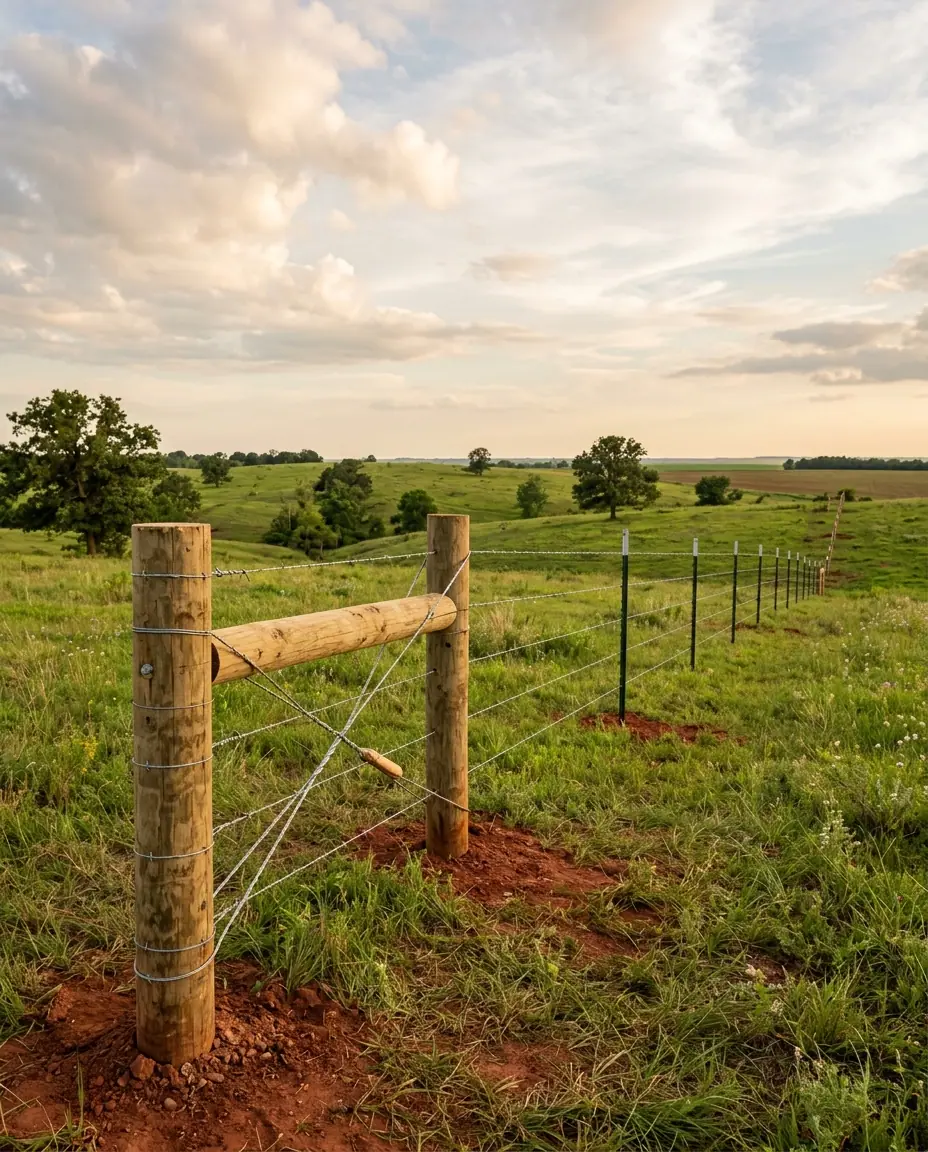
An H-brace is the assembly at each corner, end and gate: two heavy posts joined by a horizontal rail and a tensioned diagonal wire. It holds the pull of the whole wire fence. Most sagging wire fences fail at a weak brace, not along the line, so we build the braces first and build them heavy.
How far apart are T-posts on a wire fence?
Typically about 10 to 15 feet apart on open ground, closer on hills, curves and soft ground, with wire stays between posts on wider spacing to keep strands from spreading. Wood or pipe line posts every few T-posts add strength on long runs.
Can you build a fence across a creek?
Yes, with a water gap: a section built to hang across the creek that swings up or can be quickly repaired when floodwater pushes debris against it, so the flood doesn't take out the fence on either side. We plan water gaps when we walk the line.
Do you clear brush along the fence line?
We clear brush and small trees along the line as part of the job so the wire runs straight and you can drive or walk it for checks. Heavy timber or dozer work may need a separate contractor, and we'll tell you at the estimate.
High-tensile or standard barbed wire?
High-tensile wire is stronger and lighter, so it stretches less, rusts slower and needs fewer posts, but it needs solid bracing to hold its tension. Standard barbed wire is more forgiving to build and repair. We'll recommend one based on your livestock and pasture size.
Free estimate
Get a Free Ranch Fence Estimate
Tell us roughly how many feet or acres you need fenced, what livestock you’re keeping and where the property is. We’ll call to set a time to walk the line, then send a written, itemized quote.